


























Supreme Court Says Frank Musa Dean Is Cleared in 53-Carat Diamond Dispute

Monrovia, Liberia: The long-running legal battle over a massive diamond discovered in western Liberia has taken a decisive turn, bringing clarity to questions of responsibility and accountability. What began as a dispute over ownership and government authority has now culminated in a Supreme Court ruling that sharply defines the limits of personal liability for public officials placing former Minister of Justice and Attorney General Cllr. Frank Musa Dean outside the scope of blame in the controversial matter.
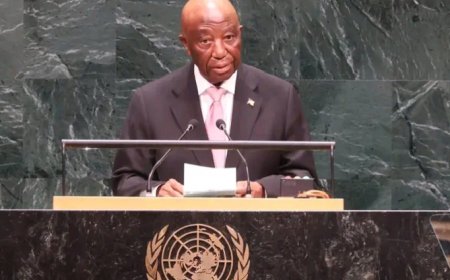
The Supreme Court of Liberia has formally absolved Cllr. Frank Musa Dean of any personal responsibility in the prolonged controversy involving a 53.3-carat diamond, holding that a lower court wrongly attempted to enforce the Court’s mandate against him as an individual. In an opinion authored by Chief Justice Yamie Quiqui Gbeisay, Sr., the Court emphasized that its prior judgment never identified or held Dean personally accountable for returning the diamond or paying its monetary value.
According to the Chief Justice, the original mandate clearly directed the Government of Liberia, acting through the Ministry of Mines and Energy, to ensure restitution of the diamond or its equivalent value. At no point, the Court stressed, did the judgment single out Dean or assign him personal liability. As a result, the trial court’s attempt to enforce the mandate against him was deemed improper.
The Supreme Court further ruled that the bill of information used to pursue enforcement against Dean was procedurally flawed. The Court concluded that the lower court acted incorrectly in its method of enforcing the mandate, stating unequivocally that the approach taken was not supported by law.
Reacting to the ruling, Cllr. Dean welcomed the Court’s decision, describing it as confirmation of his consistent position that he acted strictly within the bounds of his official responsibilities. He also warned against what he called a dangerous trend of broadly labeling public servants as corrupt.
Dean argued that such sweeping accusations discourage honest citizens from entering public service, creating space for unethical behavior to flourish. He lamented what he described as a growing atmosphere of bitterness and resentment, urging Liberians to adopt a more constructive and fair-minded approach toward national issues.
Reflecting on his tenure as Minister of Justice, Dean noted that he faced criticism from multiple directions but remained committed to upholding the rule of law. He pointed to his oversight of the nation’s security institutions during recent elections, which he said were conducted peacefully and transparently despite intense scrutiny.
With the Supreme Court’s clarification, the Civil Law Court is now free to proceed with the case as it relates to other parties still named in the dispute.
The case traces back to 2023, when a 53.34-carat rough diamond was discovered in Smith Town, Gbarma Mining District #2, Gbarpolu County. Competing claims over the diamond quickly surfaced. Local miners T. David Sluward and Abraham Kamara represented by former Solicitor General Cllr. Sayma Syrenius Cephus asserted ownership, while the Government of Liberia claimed the mining license for the site had expired.
Relying on Section 9.9 of the New Minerals and Mining Law of 2000, the government argued that ownership of the diamond reverted to the state once the license lapsed. However, in 2024, the Supreme Court ruled in favor of Sluward and Kamara, recognizing them as the rightful owners and instructing the Civil Law Court to enforce its decision.
In enforcing the judgment, Civil Law Court Judge Boima Kontoe issued orders that extended beyond restitution. Several former officials—including ex–Mines and Energy Minister Gesler Murray, former Assistant Minister Emmanuel T.T. Swen, Diamond Dealers Association President Mustapha Tounkara, Ishaka Conneh (also known as “Bakut”), and appraiser Korvah Baysah—were arrested and detained at Monrovia Central Prison.
These actions prompted renewed scrutiny, leading to the Supreme Court’s clarification that its mandate could not be enforced against individuals who were neither named nor found personally liable in its judgment.
Chief Justice Gbeisay reiterated that the Court’s ruling was strictly against the Government of Liberia, operating through the Ministry of Mines and Energy. He explained that a bill of information cannot be used to impose personal liability where no such liability was established in the original judgment.
Prior to the ruling, Dean had petitioned the Supreme Court to stop enforcement of Judge Kontoe’s order, arguing that neither his name nor the Ministry of Justice appeared anywhere in the judgment. His legal filing underscored that the decision referenced only officials of the Ministry of Mines and Energy and those acting under its authority.
Dean maintained that the Ministry of Justice’s sole involvement was issuing a legal opinion—based on information provided by the Ministry of Mines and Energy that the mining license had expired. He stressed that no additional action was taken by his ministry beyond that advisory role.
He also sought contempt proceedings against Judge Kontoe and the private claimants, arguing that the Court’s mandate had been misapplied.
Dean pointed to a January 3, 2023 press release from the Ministry of Mines and Energy, which disclosed that the diamond dealer/exporter paid over US$80,000 to the government, including royalty taxes and a fine imposed for purchasing a diamond from an expired claim. He argued this demonstrated that the Ministry of Justice had no financial or administrative involvement in the transaction.
He further cited findings from a Joint Security Board of Inquiry established in April 2023, which included representatives from multiple security and government institutions. The Board concluded that the diamond was found on a mining claim whose license had expired nearly a year earlier.
What's Your Reaction?
 Like
0
Like
0
 Dislike
0
Dislike
0
 Love
0
Love
0
 Funny
0
Funny
0
 Angry
0
Angry
0
 Sad
0
Sad
0
 Wow
0
Wow
0