





































3.5-Magnitude Earthquake Jolts Central Kansas, Rattling Residents Near Assaria
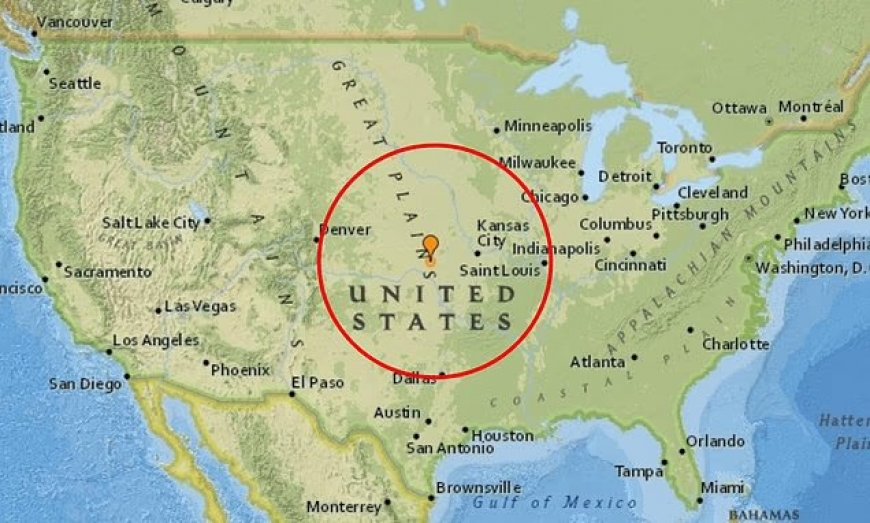
ASSARIA, Kansas: A 3.5-magnitude earthquake shook central Kansas on Wednesday afternoon, unsettling residents in the small community of Assaria and surrounding areas. The tremor struck at 2:14 p.m. local time (3:14 p.m. ET), according to the U.S. Geological Survey (USGS), sending a jolt through an area underlain by ancient volcanic rock.
Although Kansas has no active volcanoes today, the quake occurred in a region shaped by the Midcontinent Rift System, a massive tectonic event from hundreds of millions of years ago that nearly split North America. Magma from that distant period left behind hardened igneous rock and deep fractures thousands of feet below the surface, which can still influence seismic activity today.
The earthquake was linked to the Humboldt Fault Zone, a major structural feature stretching across eastern Kansas. Geologists describe the fault as a network of fractures and buried faults formed long ago, capable of producing small to moderate earthquakes when stress builds along hidden fractures.
“Even minor shifts along these ancient faults can be felt at the surface, especially in areas where they intersect layers of ancient volcanic rock,” a USGS scientist said.
Residents reported noticeable shaking, describing the tremor as sounding like “a huge clap of thunder.” Several said their homes and cars shook briefly, though no injuries or damage have been reported. Since the event, the USGS has received 16 reports of shaking from locals.
Scientists note that the North American plate is under constant slow-moving stress, which tends to concentrate along pre-existing weaknesses in the crust. When enough strain builds, rocks can suddenly slip, releasing energy as seismic waves. While Kansas’s extinct volcanoes no longer pose a direct threat, the structural weaknesses they left behind, combined with the Humboldt Fault, still influence where earthquakes occur.
The Humboldt Fault Zone has the potential to produce moderate to potentially damaging earthquakes. The largest historical earthquake along the fault, in 1867, is estimated at magnitude 5.0 to 5.5. While less active than other U.S. seismic zones, it is connected to the Nemaha Ridge, a major structural feature capable of generating significant tremors.
Scientists caution that, though recent activity has been relatively minor, the fault could theoretically produce an earthquake as strong as magnitude 6.5 to 6.7. Some small modern tremors have even been linked to human activity, including wastewater injection.
For now, Assaria residents are left with a reminder that even the quiet Kansas plains can harbor echoes of Earth’s ancient upheavals.
What's Your Reaction?
 Like
0
Like
0
 Dislike
0
Dislike
0
 Love
0
Love
0
 Funny
0
Funny
0
 Angry
0
Angry
0
 Sad
0
Sad
0
 Wow
0
Wow
0