



















UN Chief Demands Permanent African Seat on UN Security Council Amid Call for Global Financial Reform
UN Secretary-General António Guterres calls for permanent African representation on the UN Security Council and reforms to global financial systems during high-level engagements in Nairobi, Kenya.

KENYAN, NAIROBI — May 12, 2026: The United Nations Secretary-General António Guterres has intensified demands for sweeping reforms within global governance and international financial institutions, declaring in Nairobi, Kenya, that Africa must secure permanent representation on the United Nations Security Council while also gaining fairer access to development financing.
SG Guterres further criticized what he described as a “deeply unfair” global financial architecture that continues to burden African economies with high borrowing costs, mounting debt pressures, and limited influence within key international decision-making structures.
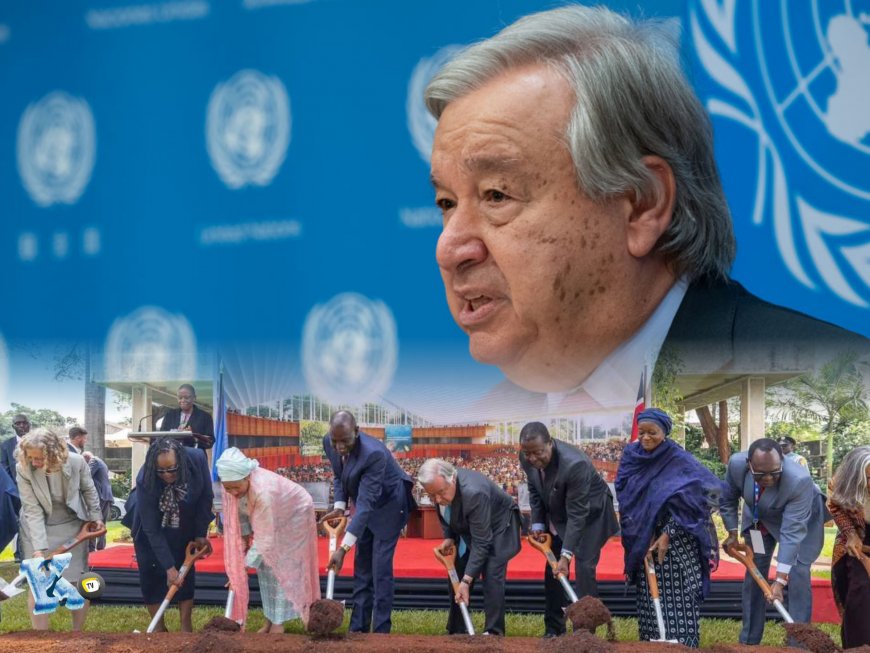
Speaking on May 11, 2026 during a high-profile engagement alongside Kenyan President William Ruto, Guterres presided over the groundbreaking ceremony for a major $340 million expansion project at the United Nations Office at Nairobi, where he described the initiative as “a symbol of our collective ambition” and emphasized that Nairobi remains a critical operational pillar for the United Nations as its only headquarters located in the Global South.
The expansion project is expected to significantly strengthen diplomatic coordination, humanitarian operations, and development programming across Africa and other regions.
The Secretary-General’s visit coincides with the inaugural Africa Forward Summit, which is taking place from May 11 to 12 in Nairobi and has brought together more than 30 African Heads of State, senior policymakers, development partners, and international institutions to deliberate on governance reforms, economic transformation, climate resilience, and Africa’s expanding role within global affairs.
Guterres, who arrived in Kenya on the night of Sunday, May 10, is expected to continue a series of high-level diplomatic engagements through today.
Addressing journalists after the groundbreaking ceremony, Guterres praised Kenya for what he termed its “continued support and strong investment” in strengthening the United Nations’ presence on the African continent, while acknowledging the country’s growing strategic significance within regional diplomacy and multilateral cooperation.
He further credited the Kenyan government for creating an enabling environment that allows the United Nations to effectively coordinate operations serving millions of people across Africa and beyond.
Reflecting on Africa’s historical experience, Guterres stated that the continent suffered a “double victimization” during and after colonialism, explaining that African countries endured both direct colonial exploitation and the creation of economic systems primarily designed for the extraction of resources rather than industrial growth, regional trade integration, and sustainable domestic development.
According to him, many of those structural imbalances remain embedded within the modern global economy and continue to restrict Africa’s full development potential.
The UN Chief strongly criticized international lending systems that compel many African countries to pay significantly higher interest rates than wealthier nations when pursuing development financing, despite possessing substantial economic opportunities and youthful populations capable of driving long-term growth.
He argued that such inequalities undermine infrastructure expansion, industrial investment, and broader economic transformation across the continent, while also renewing calls for developed nations to honor long-standing climate finance commitments intended to support African countries confronting the effects of climate change.
“There can be no true global justice without permanent African representation on the UN Security Council,” Guterres declared, while also calling for greater African influence within institutions such as the International Monetary Fund and the World Bank.
He maintained that global systems established after the Second World War no longer reflect present geopolitical realities because Africa was excluded from the decision-making structures created in 1945, adding that the continent’s growing dynamism, innovation, and leadership increasingly demonstrate its readiness to shape international policy as an equal global partner.
What's Your Reaction?
 Like
0
Like
0
 Dislike
0
Dislike
0
 Love
0
Love
0
 Funny
0
Funny
0
 Angry
0
Angry
0
 Sad
0
Sad
0
 Wow
0
Wow
0