






















Liberia Nursing Board Assesses Several Aspiring Nurses, Midwives for Potential Licensing
The Liberia Board for Nursing and Midwifery (LBNM) has embarked on a thorough scrutiny of over 600 aspiring nurses and midwives seeking professional licenses in the health sector. The Board is an autonomous regulatory body responsible for ensuring competence, professionalism, and ethical standards within the Nursing profession and the Midwifery profession in Liberia.
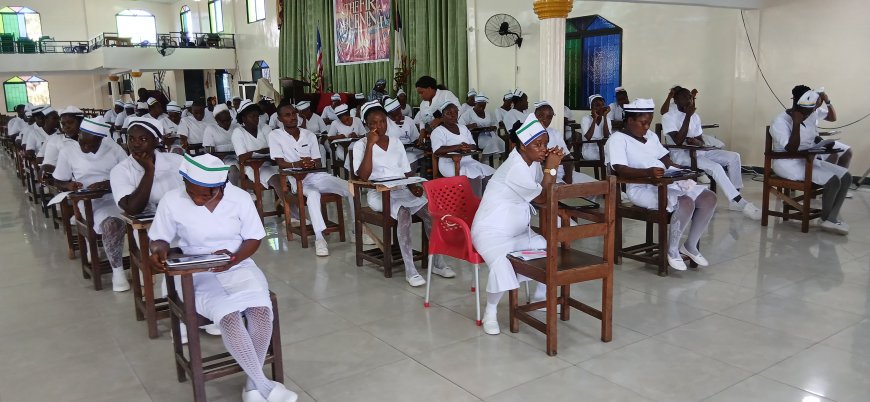
Duala, Liberia: The Liberia Board for Nursing and Midwifery (LBNM) has embarked on a thorough scrutiny of over 600 aspiring nurses and midwives seeking professional licenses in the health sector.
By: Alvinna B. Gbeingan
The Board is an autonomous regulatory body responsible for ensuring competence, professionalism, and ethical standards within the Nursing profession and the Midwifery profession in Liberia.
The ongoing national board examination, the first for 2026, brings together graduating nursing and midwifery students who are being tested in five core areas of their professional studies.
The subjects include Anatomical Nursing, Medical-Surgical Nursing, Tropical and Communicable Diseases for Nurses and Midwives, Psychiatric Nursing, and Pediatric Nursing.
According to the Board, candidates are required to obtain at least a 70 percent mark in each of the core subjects as a prerequisite for being eligible to obtain a professional license to practice in Liberia legally.
The examination process is currently being administered at the Greater Mission College campus in Duala, outside Monrovia. According to officials, this year's assessment runs from May 18-22, 2026.
Speaking during the official commencement of the process, LBNM Director for Education, Testing, and Evaluation, Shelley A. Wright, disclosed that the examination process forms part of the Board’s broader mandate to regulate nursing and midwifery practice nationwide.
Wright described nurses and midwives as key players in the health sector and emphasized that thoroughly assessing candidates before accreditation would enhance competence in workplaces.
She maintained that both graduates and graduating students from institutions accredited by the Board are eligible to sit the examination and pursue professional licenses.
Wright also used the medium to warn against the operation of illegal nursing institutions, stressing that the Board remains committed to maintaining professional standards and protecting public safety.
“The candidates you see here are all from accredited schools. The school has to be accredited and once you are accredited, you are in our database.”
“That is why we are fighting illegal schools, because we don’t want people to dilute the practice and kill us,” she emphasized.
Meanwhile, Wright assured the public that the ongoing examinations would be conducted with fairness, transparency, and accountability.
Also speaking during the exercise, one of the examination proctors, Abedego S. Allison, attributed challenges faced by candidates during the testing to anxiety and difficulties adapting to the digital testing system.
He indicated that the examination process has transitioned from the traditional paper-based format to a digital system.
“The digital one is more convenient and effective. If you make a mistake, you can go back and correct it easily, unlike the paper-based system where excessive erasing sometimes creates problems for students", he stated.
However, a student nurse, Esther Jermaine of Grand Bassa University, at the opening of the process, described the examinations as reflective of what medical professionals have already experienced during their academic and clinical training.
She noted that the state board examination remains a major requirement for professional certification and future employment opportunities within the health sector.
Jermaine also encouraged aspiring nurses and midwives to prioritize patient care and professionalism over appearances.
The ongoing examinations come amid continued efforts by the Liberia Board for Nursing and Midwifery to strengthen healthcare standards and ensure that competent professionals enter the country’s medical workforce.
Liberia’s health sector continues to face serious systemic challenges, including underfunding and a critical shortage of healthcare professionals.
Unregulated and unauthorized medical practice by unlicensed personnel has reportedly contributed to preventable deaths in some communities.
In 2025, the Liberia Medical and Dental Council (LMDC), in collaboration with the Ministry of Justice, shut down the Lofa Medic Services Clinic in Neezoe, Jacob Town, after reports emerged that the clinic’s administrator, Sam Worlobah, allegedly misprescribed medication for a man, resulting in the patient's death.
Medical experts believe that regular examinations and compulsory licensing, as enforced by the Liberia Board for Nursing and Midwifery, will help eliminate impersonation and strengthen professional competence within Liberia’s healthcare sector.
What's Your Reaction?
 Like
0
Like
0
 Dislike
0
Dislike
0
 Love
1
Love
1
 Funny
0
Funny
0
 Angry
0
Angry
0
 Sad
0
Sad
0
 Wow
0
Wow
0