









"Supreme Court Rejects Hage Family's Prohibition Petition, Orders Lower Court to Continue Fraud-in-Title Case"

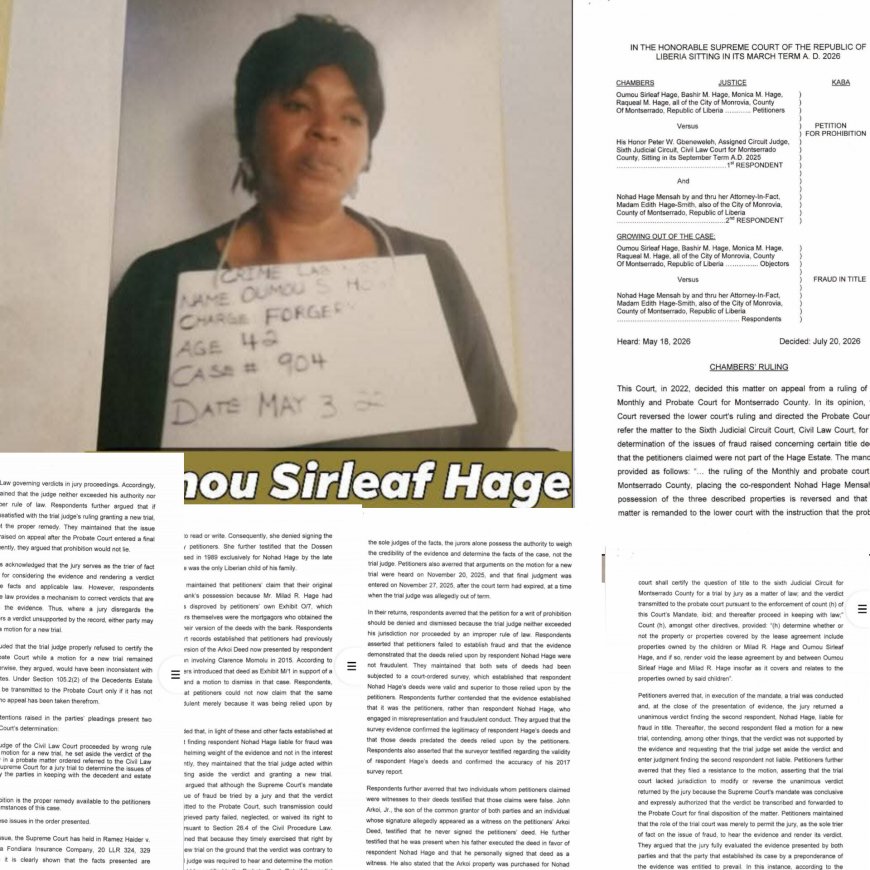
Monrovia, Liberia:The Supreme Court of Liberia, sitting in Chambers, has denied a petition for a writ of prohibition filed by Oumou Sirleaf Hage, Bashir M. Hage, Monica M. Hage and Raqueal M. Hage, ruling that the Sixth Judicial Circuit Civil Law Court acted within its legal authority when it set aside a jury verdict and granted a new trial in a long-running fraud-in-title dispute involving the Hage family estate.
In a ruling delivered on July 20, 2026, Assigned Justice Yussif D. Kaba held that the trial judge did not exceed his jurisdiction or apply the wrong rule of law by entertaining and granting a motion for a new trial after a jury had returned a verdict finding Nohad Hage Mensah liable for fraud in title. The Supreme Court therefore quashed the alternative writ of prohibition and ordered the lower court to resume jurisdiction over the matter.
The dispute stems from an earlier Supreme Court decision in 2022 that reversed a ruling of the Monthly and Probate Court for Montserrado County and directed that allegations of fraud concerning disputed title deeds be determined by a jury in the Civil Law Court. Following that trial, the jury unanimously found in favor of the Hage petitioners, prompting Nohad Hage Mensah, through her Attorney-in-Fact Edith Hage-Smith, to seek a new trial on grounds that the verdict was contrary to the evidence.
The petitioners argued before the Supreme Court that the trial judge had no authority to overturn or interfere with the jury's verdict because the High Court's earlier mandate required only that the verdict be certified and transmitted to the Probate Court. They further maintained that granting a new trial amounted to modifying the Supreme Court's mandate and undermined the constitutional role of the jury as the sole judge of factual issues, including allegations of fraud.
Respondents, however, contended that Liberian law permits a trial judge to set aside a jury verdict that is against the weight of the evidence. They maintained that witness testimony, survey reports and documentary evidence demonstrated that Nohad Hage Mensah's deeds were genuine and superior, while challenging the authenticity of the deeds relied upon by the petitioners. They further argued that prohibition was not the proper legal remedy because the trial judge acted within his statutory authority.
Justice Kaba agreed with the respondents, holding that Section 26.4 of Liberia's Civil Procedure Law gives trial judges discretion to grant a new trial where a jury's verdict is contrary to the weight of the evidence or where the interests of justice require it. The Court emphasized that there is no legal distinction between jury verdicts rendered following a Supreme Court mandate and those reached during ordinary civil proceedings, adding that any challenge to a judge's exercise of that discretion must be pursued through the appropriate legal channels.
The Supreme Court also ruled that prohibition was unavailable because the trial judge neither exceeded his jurisdiction nor proceeded under an improper rule of law. The Court further clarified that if the petitioners believed the trial judge had improperly interpreted or violated the Supreme Court's previous mandate, the proper remedy would have been a Bill of Information rather than a petition for prohibition. The Clerk of the Supreme Court has been directed to issue a mandate instructing the Civil Law Court to resume proceedings in accordance with the ruling.
What's Your Reaction?
 Like
0
Like
0
 Dislike
0
Dislike
0
 Love
0
Love
0
 Funny
0
Funny
0
 Angry
0
Angry
0
 Sad
0
Sad
0
 Wow
0
Wow
0