







































Nyantarku Public School Faces Enrollment Decline Following Destructive Windstorm

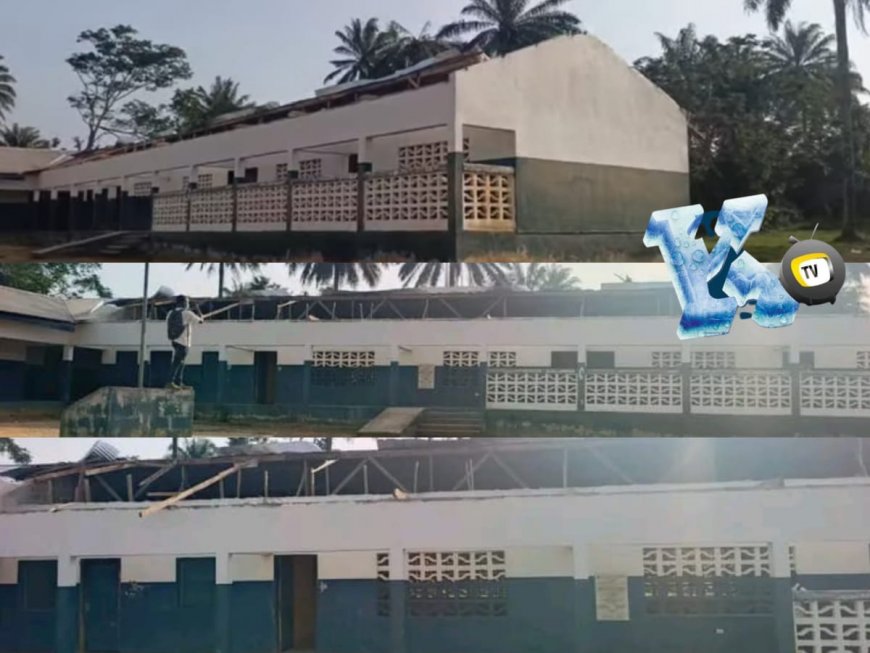
BONG COUNTY, LIBERIA: Nyantarku Public School, a primary educational institution serving Koryah Town and its surrounding villages in Panta District, is experiencing a notable decline in student enrollment following a destructive windstorm that severely damaged the school’s infrastructure and disrupted academic activities.
The school, which has long functioned as a critical pillar of rural education in Bong County, was struck by a violent rainstorm on November 15, 2025, an event now regarded by local authorities and residents as the most significant setback in its recent history.
The storm tore the roofs off four classrooms, leaving large sections of the campus exposed and rendering the learning environment largely unconducive for pupils and teachers alike.
Although comprehensive public records detailing the school’s founding remain limited, Nyantarku Public School is widely recognised for its longstanding role in providing accessible, government-supported primary education to children from underserved rural communities.
Prior to the storm, the institution operated with several dedicated classroom structures, though concerns had persistently been raised by parents and local education stakeholders about the ageing nature of its facilities, particularly when contrasted with newer, state-of-the-art secondary schools constructed in urban centres such as Gbarnga.
In the aftermath of the storm, school administrators were compelled to adopt emergency measures in order to sustain academic instruction. With four classrooms rendered unusable, multiple classes were merged into the remaining spaces, creating overcrowded conditions that have since strained both instructional quality and student wellbeing.
Speaking to the media, the school's Principal, John Yarkapawolo confirmed that nearly 20 students have withdrawn from the school since the incident, a development he attributed to growing parental anxiety over safety, overcrowding, and the overall deterioration of learning conditions.
“We have already lost close to 20 students, and the number continues to increase as parents become more worried each day,” he said.
He warned that enrollment continues to decline, placing the school’s academic stability for the 2025–2026 academic year at serious risk.
According to Principal Yarkapawolo, the sustained disruption threatens to derail the educational progress of many children within Koryah Town and neighbouring villages.
“If this situation is not addressed urgently, some children may stay home for too long, and others may never return to school,” he cautioned.
The consolidation of classes has led to learning environments originally designed for approximately forty-five pupils now accommodating far greater numbers.
Teachers report that excessive heat, poor ventilation, and limited space have become daily challenges, significantly undermining effective teaching and student concentration.
Parents and guardians have been frequently observed around the damaged school premises, closely monitoring the situation with visible apprehension.
Many have questioned whether meaningful learning can be sustained under conditions that compromise both safety and comfort.
“This place is no longer good for learning,” one parent remarked, as others looked on anxiously.
Principal Yarkapawolo, who has been a consistent advocate for government support to strengthen the school’s resilience against climate-related disasters, described the storm as sudden and unusually severe.
“This was completely unexpected, and climate change is playing a major role in what we are facing today,” he said, stressing that the school lacks the financial and technical capacity to undertake major repairs independently.
What's Your Reaction?
 Like
0
Like
0
 Dislike
0
Dislike
0
 Love
0
Love
0
 Funny
0
Funny
0
 Angry
0
Angry
0
 Sad
0
Sad
0
 Wow
0
Wow
0