





























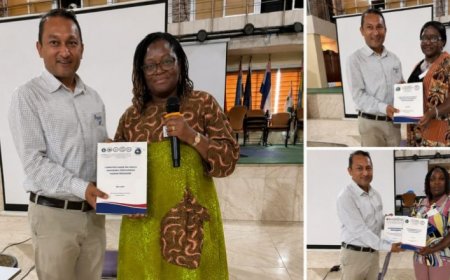






WATAF Tax Reform Drive Exposes Gaps in Enforcement, Impact and Real-World Change
A renewed regional push to strengthen tax systems across West Africa is gaining momentum under the West African Tax Administration Forum (WATAF), but beneath the surface of technical engagement, critical questions are emerging about whether the initiative can truly deliver enforcement, measurable impact, and lasting institutional change. At the center of this push is a five-day capacity-building program built around the Tax Administration Diagnostic Assessment Tool (TADAT), a globally recognized framework designed to evaluate the efficiency and effectiveness of national tax administrations. While the program is being promoted as a major step toward modernization, it is also reigniting long-standing concerns about whether such diagnostic exercises translate into real reform beyond the training environment.

Abuja, Nigeria: A renewed regional push to strengthen tax systems across West Africa is gaining momentum under the West African Tax Administration Forum (WATAF), but beneath the surface of technical engagement, critical questions are emerging about whether the initiative can truly deliver enforcement, measurable impact, and lasting institutional change.
At the center of this push is a five-day capacity-building program built around the Tax Administration Diagnostic Assessment Tool (TADAT), a globally recognized framework designed to evaluate the efficiency and effectiveness of national tax administrations. While the program is being promoted as a major step toward modernization, it is also reigniting long-standing concerns about whether such diagnostic exercises translate into real reform beyond the training environment.
Those concerns are further amplified by the scale of participation, with more than 270 tax officials drawn from Liberia and six other West African countries engaging in the training. The sessions are focusing on core areas such as taxpayer registration systems, compliance management, dispute resolution mechanisms, and transparency structures—key pillars that continue to define the strength or weakness of revenue authorities across the region.
However, as technical discussions deepen, a significant gap remains in the absence of country-specific diagnostic outputs, making it difficult to clearly assess how individual tax administrations compare or where the most urgent institutional weaknesses lie. That lack of disaggregated data, in turn, limits the ability to connect regional training efforts with targeted national reform strategies.
Against this backdrop, WATAF Executive Secretary Jules Tapsoba has reiterated that inefficient tax systems are costing West African economies billions in lost revenue, weakening governments’ capacity to fund essential services. Yet despite the gravity of that warning, the absence of detailed, country-by-country breakdowns continues to raise questions about where exactly those losses are concentrated and how they are being measured.
As these concerns persist, attention is shifting from diagnosis to execution, particularly around whether the current framework provides a clear pathway for enforcement. While TADAT is designed to identify institutional weaknesses with precision, the program offers limited clarity on how recommendations will be implemented, who will ensure compliance, and what accountability structures will bind national authorities to reform commitments.
The implementation gap becomes even more significant when viewed against the broader fiscal pressures facing West African states, including Liberia, where governments continue to struggle with narrow revenue bases, rising public demand, and increasing dependence on external financing.
Despite repeated reform cycles in the past, the region’s experience has often shown that capacity-building initiatives risk stalling at the level of workshops and technical engagements, without fully evolving into structural or behavioral change within tax institutions.
Compounding these concerns is the issue of transparency, particularly whether the findings generated through the TADAT assessments will be made public or retained within administrative systems. The uncertainty raises broader questions about citizen oversight, civil society engagement, and the role of the media in tracking whether promised reforms are actually implemented.
Ultimately, the initiative reflects both progress and limitation in equal measure—progress in terms of technical coordination and regional collaboration, but limitation in the absence of clearly defined enforcement pathways and measurable accountability structures.
What's Your Reaction?
 Like
0
Like
0
 Dislike
0
Dislike
0
 Love
0
Love
0
 Funny
0
Funny
0
 Angry
0
Angry
0
 Sad
0
Sad
0
 Wow
0
Wow
0