






































LCAA, BAGASOO Launch Major Aviation Safety Overhaul To Strengthens National Oversight
LCAA and BAGASOO have introduced a comprehensive aviation safety reform in Liberia focused on enhancing oversight, reducing operational risks, and implementing global safety frameworks through SSP and NASP to improve national and regional aviation performance.

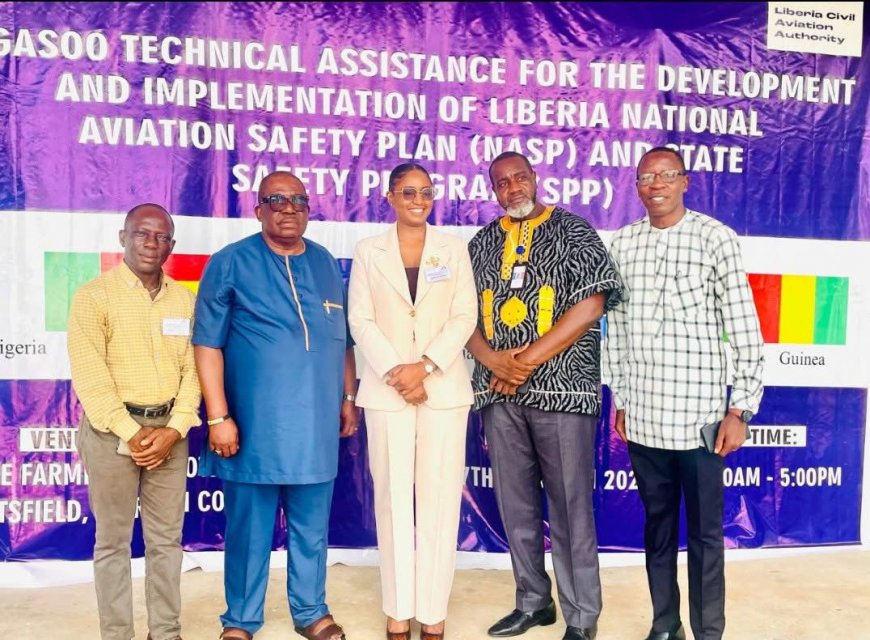
MONROVIA, LIBERIA — April 30, 2026: The Liberia Civil Aviation Authority (LCAA), in collaboration with the Banjo Accord Group Aviation Safety Oversight Organization (BAGASOO), has officially launched a major aviation safety overhaul designed to reinforce national oversight systems, reduce operational risks, and align Liberia’s aviation sector with international regulatory and safety standards through structured policy implementation and coordinated institutional reforms.
The initiative introduces a comprehensive safety architecture anchored on the State Safety Program (SSP) and the National Aviation Safety Plan (NASP), both designed to modernize aviation governance, strengthen risk management systems, and establish measurable safety performance benchmarks across all operational levels of the country’s aviation ecosystem.
According to the LCAA, the reform framework is intended to shift aviation safety management from reactive enforcement to proactive risk identification and mitigation, ensuring that safety oversight is embedded in continuous monitoring, data analysis, and systematic regulatory compliance across all relevant institutions.
Speaking at the official launch on Wednesday, April 29, 2026, LCAA Director General Julius D. Dennis described the initiative as a defining transition in Liberia’s aviation safety structure, noting that the State Safety Program introduces a structured national system for managing aviation safety through policy development, risk control mechanisms, safety assurance processes, and sustained safety promotion activities.
He further explained that the National Aviation Safety Plan will translate the broader framework into operational execution by identifying national safety priorities, setting performance indicators, and introducing targeted interventions aimed at reducing hazards and strengthening regulatory responsiveness across the sector.
Dennis emphasized that the success of the initiative depends on coordinated implementation among stakeholders within the aviation industry, underscoring that stronger institutional alignment will directly influence safety outcomes and operational discipline across the system.
He stated, “The State Safety Program provides a structured national framework for managing aviation safety through effective policy development, risk management, safety assurance, and continuous safety promotion.”
He further added that “the NASP will identify key national safety priorities, set measurable performance targets, and introduce targeted initiatives aimed at mitigating operational risks,” noting that sustained collaboration among stakeholders will be central to building a resilient and accountable aviation safety culture in Liberia.
Representing BAGASOO, Aviation Safety Expert Jacob Idawuo highlighted the importance of continuous and data-driven safety management, stressing that aviation safety systems must be built on consistent evaluation, structured planning, and responsive intervention strategies that evolve with operational realities.
He explained that the implementation process will involve a detailed assessment of Liberia’s current aviation safety performance, analysis of sector-wide data, identification of priority risks, and establishment of measurable objectives supported by continuous monitoring and periodic reviews to address emerging challenges.
Idawuo stated, “Aviation safety is achieved through continuous and intentional effort. The NASP provides a data-driven roadmap that helps identify hazards, allocate resources efficiently, and implement targeted measures to reduce accidents and serious incidents.”
Both LCAA and BAGASOO reaffirmed their commitment to strengthening aviation safety coordination not only within Liberia but across the West African subregion, with a focus on harmonized oversight systems, improved regulatory compliance, and enhanced safety performance standards that align with international aviation requirements.
What's Your Reaction?
 Like
0
Like
0
 Dislike
0
Dislike
0
 Love
0
Love
0
 Funny
0
Funny
0
 Angry
0
Angry
0
 Sad
0
Sad
0
 Wow
0
Wow
0