














“Open the Barracks to More Liberians” — Rep. Bannie Pushes Bold Reform to Expand AFL Recruitment
In a move that could significantly reshape the composition of Liberia’s military, Grand Bassa County District #1 Representative, Hon. Isaac Bannie, has submitted a sweeping bill seeking to amend key provisions of the 2008 National Defense Act, declaring that “the time has come to broaden opportunity and strengthen national defense through inclusion.” The proposal, introduced on Monday, April 13, during the opening sitting of the House of Representatives’ Special Session, April 13, calls for the repeal and amendment of Section 7.2 of the existing law, with Representative Bannie emphasizing that “our current recruitment structure does not fully reflect the realities and aspirations of today’s Liberia.”

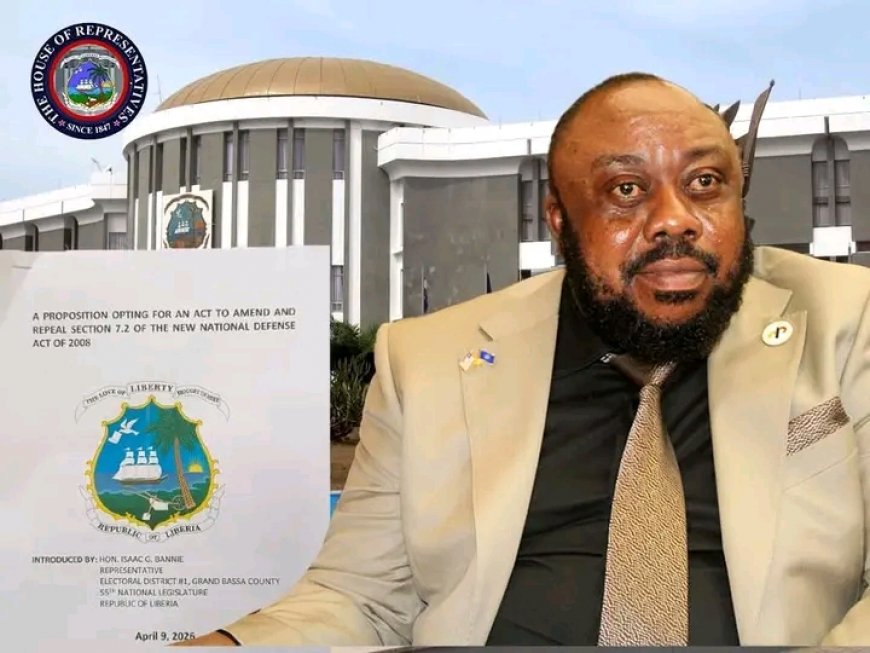
Monrovia, Liberia: In a move that could significantly reshape the composition of Liberia’s military, Grand Bassa County District #1 Representative, Hon. Isaac Bannie, has submitted a sweeping bill seeking to amend key provisions of the 2008 National Defense Act, declaring that “the time has come to broaden opportunity and strengthen national defense through inclusion.”
The proposal, introduced on Monday, April 13, during the opening sitting of the House of Representatives’ Special Session, April 13, calls for the repeal and amendment of Section 7.2 of the existing law, with Representative Bannie emphasizing that “our current recruitment structure does not fully reflect the realities and aspirations of today’s Liberia.”
At the heart of the bill is a provision to expand eligibility for enlistment into the Armed Forces of Liberia (AFL), allowing “all qualified Liberians between the ages of 18 and 35” to serve, provided they meet professional, medical, and physical fitness standards set by the military.
Notably, the draft legislation lowers the minimum educational requirement to a 7th-grade level, a decision Bannie defends as both practical and inclusive. “We must not deny willing and able citizens the chance to serve simply because of limited formal education,” he argued, adding that “patriotism and discipline cannot be measured by certificates alone.”
To safeguard integrity within the ranks, the bill mandates the establishment of a robust vetting committee under the Ministry of National Defense.
According to the draft, the committee will ensure that “no individual with a record of human rights abuses or violations is admitted into the AFL.”
The legislation also reinforces the principle of national representation, stressing that the AFL “must at all times reflect the national character of Liberia,” a clause aimed at promoting fairness, unity, and equal participation across all counties and social groups.
Implementation responsibilities, once the bill is passed, will rest with the Ministry of National Defense in collaboration with the AFL Command Authority. The framework, Bannie noted, is designed to ensure that “expansion does not come at the expense of professionalism, discipline, or respect for human rights.”
Defending the urgency of the reform, the lawmaker stated, “A stronger, more inclusive military is essential to safeguarding our sovereignty and responding effectively to emerging security challenges,” adding that the bill will “create a pathway for thousands of young Liberians eager to serve their country.”
Following its formal submission, the proposed amendment has been forwarded to the relevant committee for detailed scrutiny.
Lawmakers are expected to review its implications before presenting a report to Plenary, setting the stage for what could become a defining debate on the future of Liberia’s defense policy.
What's Your Reaction?
 Like
0
Like
0
 Dislike
0
Dislike
0
 Love
0
Love
0
 Funny
0
Funny
0
 Angry
0
Angry
0
 Sad
0
Sad
0
 Wow
0
Wow
0