





















Who's Benefiting? Bea Mountain's Gold Boom, Foreign Workforce Fuel Concern Over Liberia's Fair Share
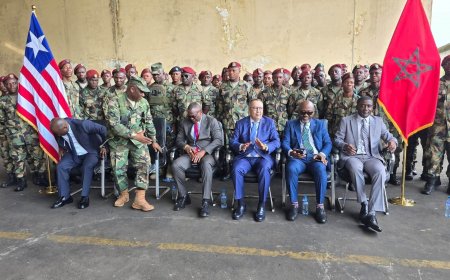
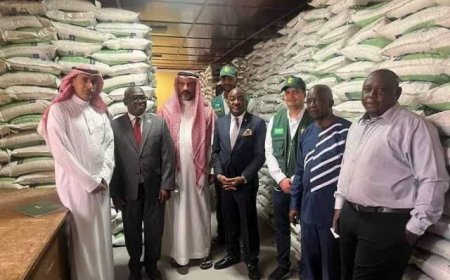
The Bea Mountain Mining Corporation operating in Kinjor, Grand Cape Mount County, is facing growing scrutiny following new disclosures about its gold production, underground expansion, and workforce composition. This is raising serious national questions about how Liberia benefits from one of its most significant mining operations. The concerns emerged from an official engagement in Grand Cape Mount County, involving Vice President Jeremiah Koung, where the company officials reportedly provided detailed operational updates that have since triggered a wider public debate.


Grand Cape Mount, Liberia: The Bea Mountain Mining Corporation operating in Kinjor, Grand Cape Mount County, is facing growing scrutiny following new disclosures about its gold production, underground expansion, and workforce composition.
This is raising serious national questions about how Liberia benefits from one of its most significant mining operations.
The concerns emerged from an official engagement in Grand Cape Mount County, involving Vice President Jeremiah Koung, where the company officials reportedly provided detailed operational updates that have since triggered a wider public debate.
High Gold Output And Underground Expansion
During the engagement, the Bea Mountain team disclosed that the company produces approximately 900 kilograms of gold every month—a figure that has intensified scrutiny over revenue flows and state benefits.
Officials also indicated that the company is expanding its operations deeper underground, signaling an increase in extraction capacity and long-term production output.
In a further development that drew attention from the delegation, the company reportedly presented a gold sample valued at approximately USD 3 million, underscoring the scale of its operations.
Foreign Workforce in Critical Processing Unit
However, the most sensitive concerns emerged during an inspection of the company’s processing and storage area.
Observations from the visit indicated that the entire section was staffed by foreign nationals, with no Liberians present in that critical operational unit.
The situation prompted immediate questions from members of the delegation about local participation in high-security and high-value segments of the mining process.
Bea Mountain officials are said to have provided only a limited response when pressed for clarification, further fueling concerns over transparency and workforce inclusion.
Political and Policy Pressure Mount
The developments have intensified a broader national debate already building around the concession.
Managing Director of the Liberia Water and Sewer Corporation, Mohammed Ali, has called for a full and transparent review of the concession agreement.
Ali argues that the arrangement must be reassessed in the national interest, insisting that the principle of “sanctity of contract” cannot be used to protect agreements that fail to deliver meaningful benefits to affected communities and the state.
He is calling for what he describes as a “review, reform, and realignment” of the concession framework.
Labor and Work Permit Controversy
Adding to the debate, Montserrado County Senator Abraham Darius Dillon has raised concerns about employment practices across concession areas, including Bea Mountain’s operations.
He alleges that foreign nationals occupy multiple skilled positions that Liberians are qualified to perform, including technical and administrative roles.
Senator Dillon further links the situation to the issuance of work permits by the Ministry of Labor Liberia, which he argues has contributed to reduced employment opportunities for Liberians.
He maintains, however, that the issue must not be politicized or misinterpreted as targeting any county or group, but treated as a national employment concern.
"The very Bea Mountain ... like many other concession companies and other private sector business entities ... they employ FOREIGN carpenters, welders, electricians, nurses, drivers, cooks, accountants, comptrollers, plumbers, etc ... thereby depriving thousands of our qualified and competent citizens the job opportunities created by signing these Concession Agreements", Senator Dillion noted.
Import Dependency and Economic Structure Concerns
Former Commerce and Industry Minister Amin Modad has added another layer of concern, focusing on import dependency and local value retention within mining operations.
Modad disclosed that during his tenure at the Ministry of Commerce and Industry Liberia, investigations revealed that Bea Mountain imported nearly 90 percent of its consumables, including basic goods such as eggs, soap, and honey, despite their availability in Liberia.
He said the government responded by restricting import permits for such goods to encourage local sourcing and stimulate domestic production, but noted that these actions reportedly triggered resistance and political backlash.
Modad is now calling for a structural overhaul of Liberia’s mining governance model, proposing a shift from royalty-based concessions to a shareholding system that would grant the state direct equity participation in mining operations.
Liberia's Royalty vs What Bea Mountain Exports
Multiple sources have revealed that Liberia receives a 3% royalty on gold and diamond production from the Bea Mountain mining concession (New Liberty Gold Mine), a rate often criticized as low compared to regional peers. Critics have pointed to annual gold exports of roughly USD $1.6 billion. This royalty is part of an amended Mineral Development Agreement (MDA) that includes 5% free equity for the state.
However, Bea Mountain Mining Corporation, a foreign-run concessionaire operating the New Liberty Gold Mine, exports significant amounts of gold from Liberia, with recent reports indicating an annual export value of approximately US$1.64 billion to over US$2.3 billion, based on monthly production estimated between 900 kg and 1,271 kg.
This makes it a major contributor to Liberia's extractive sector, though it has fueled concerns regarding local benefits.
The gold-mining company originally signed its Mineral Development Agreement (MDA) with the Liberian government on November 28, 2001. A Restated and Amended MDA was subsequently signed in September 2013, and the Liberian Senate ratified a further amendment extending the concession by 25 years in August 2023.
A Moment of National Accountability
While there is no reported operational disruption at the company, the combination of high production figures, underground expansion, foreign-dominated processing units, and import dependency concerns has placed Bea Mountain under intense national scrutiny.
The central question emerging from the debate is not only how much gold is being produced—but how much of its value remains in Liberia.
Government Under Pressure
The unfolding situation is placing increased pressure on the administration of President Joseph Boakai, with growing calls for tighter regulatory oversight, concession review, strengthened labor enforcement, and expanded local content participation.
Stakeholders say the current moment represents a critical test of the government’s commitment to its “Liberia First” agenda and broader economic reform promises.
"What is unfolding around Bea Mountain is no longer a routine concession discussion. It has become a high-stakes national accountability issue involving production scale, workforce structure, import dependency, and state benefit", a prominent figure said.
As scrutiny intensifies, attention now turns to whether the Liberian government will move toward structural reform—or allow the debate to remain unresolved despite mounting public concern.
What's Your Reaction?
 Like
0
Like
0
 Dislike
0
Dislike
0
 Love
0
Love
0
 Funny
0
Funny
0
 Angry
0
Angry
0
 Sad
0
Sad
0
 Wow
0
Wow
0