







FIFA Warns Liberia of Sanctions Amidst National Court Proceedings in Football Elections Dispute
The Federation of International Football Association (FIFA) has issued a strong caveat regarding disputes surrounding the Liberia Football Association's (LFA) upcoming elections, which are currently being addressed through the Supreme Court of Liberia. The global football governing body warned that Liberia, as a member nation, could face serious consequences—including possible suspension from international football—if its football statutes are undermined by court interference.

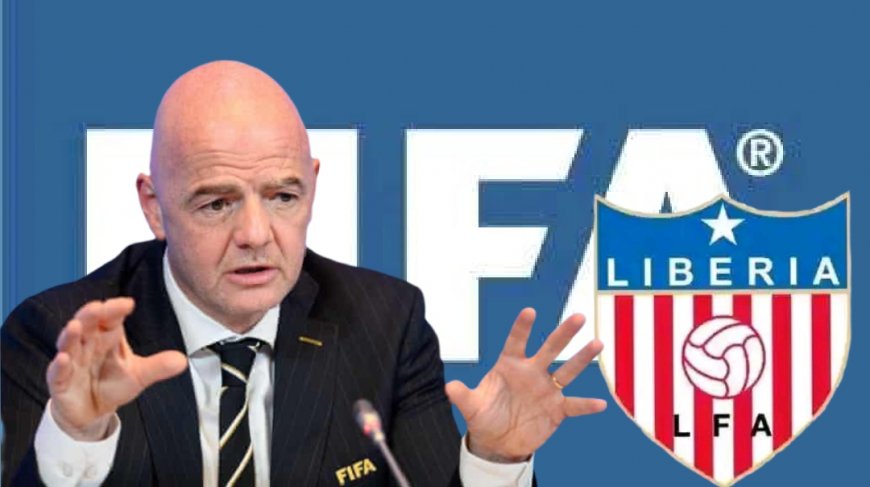
Monrovia, Liberia: The Federation of International Football Association (FIFA) has issued a strong caveat regarding disputes surrounding the Liberia Football Association's (LFA) pending elections, which are currently being addressed through the Supreme Court of Liberia.
The global football governing body warned that Liberia, as a member nation, could face serious consequences—including possible suspension from international football—if its football statutes are undermined by court interference.
FIFA's caution followed a communication from the Liberia Football Association about the ongoing developments ahead of its April 18, 2026, Elective Congress.
The LFA elections are embroiled in a legal battle over candidates’ eligibility, with a Civil Law Court of Montserrado County initially issuing an injunction on the election as prayed for by a presidential hopeful Cassell Kuoh.
Kouh who is also the President of First Division League Club Fassell, has heavily challenged the election process, citing alleged irregularities in the election guidelines in line with Article 58.1 of the LFA statutes.
The Liberia Football Association's Statutes, Chapter 25, Article 58.1, states that "The President, Vice Presidents, and Executive Committee members shall not have been found guilty of criminal offence."
Kuoh's eligibility dispute revolves around his 2017 conviction for investment fraud in the United States. He claims the election committee is focused on a specific offense and is attempting to prevent him from running.
Kuoh considers this a violation of his rights and has taken the LFA to court on multiple counts. These developments have created uncertainty about the status of the LFA election scheduled for April 18, 2026.
Amidst the looming legal conflict over the Liberia Football Association’s elections, FIFA, in a communication dated March 22, 2026, stated: "We would also like to draw your attention to the corresponding provisions contained in the LFA Statutes (2018 edition)."
"In particular, Articles 18.3(J) and 19 of the LFA Statutes require Members to adopt a statutory clause specifying that any dispute requiring arbitration and relating to the statutes, regulations, directives and decisions of FIFA, CAF, WAFU or the LFA shall come solely under the jurisdiction of the appropriate arbitration tribunal."
"Any recourse to ordinary courts is strictly prohibited, and any breach of this obligation may result in the sanctions provided for in the LFA Statutes."
While recognizing the authority of national courts, FIFA emphasized that football governance operates within a distinct legal system.
The organization stressed that the Liberia Football Association is bound by international statutes that prioritize arbitration over litigation in settling internal disputes.
Central to FIFA’s warning is Article 51 of its statutes, which explicitly bans member associations and their affiliates from taking football-related disputes to ordinary courts unless specifically permitted. These issues should instead be handled through arbitration mechanisms established in football’s regulatory framework.
This principle is not new. Historically, FIFA has enforced strict adherence to its autonomy, suspending countries like Nigeria and Kuwait in recent years over government or judicial interference, setting a precedent that influences Liberia’s current situation.
As tensions rise, FIFA urges all parties involved to respect both international and local football statutes and to resolve grievances through established sports arbitration systems.
Liberia’s football future now hangs in the balance, as this dispute could determine whether the nation remains active on the international stage or faces exclusion from global competition
What's Your Reaction?
 Like
0
Like
0
 Dislike
0
Dislike
0
 Love
0
Love
0
 Funny
0
Funny
0
 Angry
0
Angry
0
 Sad
0
Sad
0
 Wow
0
Wow
0